Monthly Archives: May 2016

Field Report 2016-03-28: Oldest Generation of Loggers Retired

Securing the backup bungie cord to the anchor.

Securing a backup bungee to the anchor plate.

I know I said I was going to keep the ocean sensors in service till they croaked, but after more than two years of operation I’ve decided to retire the two beta units to our bookshelf museum. B3 & B4 were the last loggers in our fleet based on the Tinyduino platform (and the guys back in Ohio deserve some credit for helping us get the project off the ground!)  The clincher on this decision was the practical issue of still being able to do a full calibration on those sensors, so I can apply that to all that wonderful flow data we’ve gathered from Akumal Bay over the last 14 months.  And you run a risk of loosing your loggers every time you deploy in a high energy environment.

Four Generations of Cave Pearl Data loggers

Four generations of flow sensors, spanning two years of development. Beta4 was literally the fourth data logger I ever made, and the first to run for a significant length of time.

These replacements also bring all of the ocean units into the same generation of Rocket Ultra based builds,  so they should all deliver a year of operation before they need servicing. Much as I loved the Tinyduinos, I never got them down into the 0.15mA sleep currents that I now see the MCP1700 regulator  boards delivering.  As the folks at CEA keep pushing them further out onto the reef,  it’s getting more expensive to deploy & retrieve them, so we need all the run time we can get.

The new locations also mean I can’t just pop in and exchange them on the way to the airport… like I am doing today…

Addendum:
Akumal was the last stop on a busy trip that saw us hopping all over the peninsula to visit colleagues while staying in towns from Tulum to Chiquila.  You see allot of beautiful things outside the tourist strip that never end up in the brochures, but you never quite escape the influence that radiates from that heaving mass of transient humanity.

I think this is reflected in the work of the local artists:

Contrast

<— Click here to continue reading the story—>

Field Report 2016-03-27: Progress on the 1-Wire DS18B20 Temperature Strings

Happy to report the successful deployment of three more temperature strings:


and I think it’s fair to say the first two protoypes have almost run their course:

Logger/Sensors Time/Max.Depth Comment
#45  (19 x 25cm)
[1st build]
201503-08
(14m)
Full data from Temp chain, Qsil problem on pressure sensor
         (19 x 25cm) 201508-12
(6m)
Wire break on 1st segment before deployment: total read failure on temps, pressure data OK
         (11 x 25cm) 201512-1603
(7m)
Full record including pressure. Segment wire broke during retrieval. Brought home for refurb.
#46  (20 x 50cm)
[2nd build]
201503-08
(16m)
Full temp record. Pressure record problem.
         (20 x 50cm) 201508-12
(24m)
Full temp record. Pressure OK after Qsil removed.
        (9 x 50cm) 201512-1603
(24m)
3rd segment wire break during deployment dive. Nine sensors report OK for duration. Pressure OK. Failed segment removed & unit re-deployed.
#78  (24 x 100cm)
[3rd]
201512-1603
(16m)
Complete data record. Unit redeployed.
#79  (24 x 25cm,  & 10m extension)
[4th]
201512-1603
(16m)
Wire break during deployment dive. Full logs saved but no data. Failed segment removed & unit re-deployed w 18 nodes
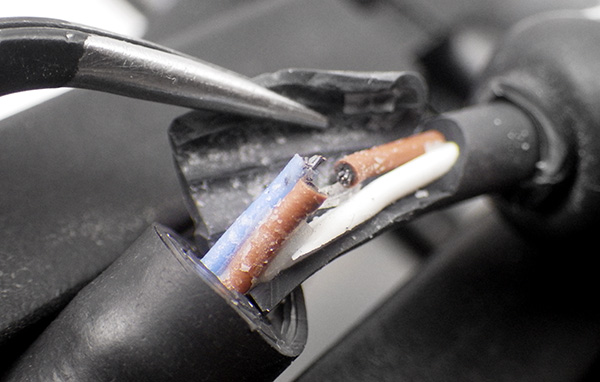
These internal wire failures did not compromise the integrity of the outer jacket.

Fortunately none of these internal wire failures compromised the integrity of the outer jacket. These are only 7-strand wires, and I will be hunting for more flexible 19 strand replacements.

While it’s hard to see all that work deliver only a few successful deployments, I’m happy to note the failures were all at physical pinch points in the cable, with no other apparent problems on the housings or electronics.  And even when the wires break, the logger itself keeps chugging along: saving logs full of 1360 & -1 read errors.  Sensor problems like this often take a whole logger down, but the MS5803’s delivered data through every deployment, so failures on the one wire bus seem to be isolated from the rest of the sensors on the logger.

RIMG8849

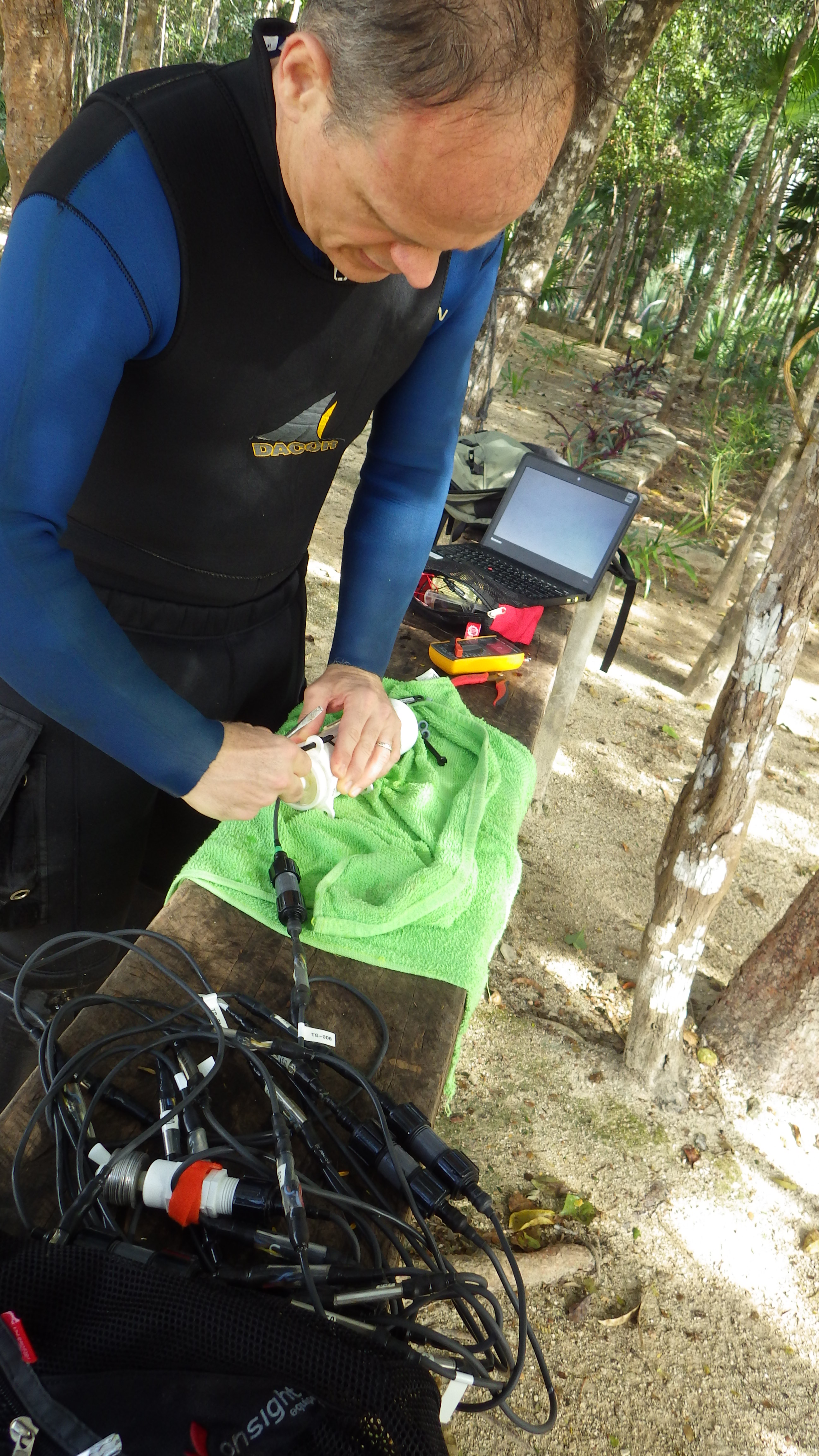
Though it was always part of the plan, actually pulling off segment swaps in real time was pretty cool…

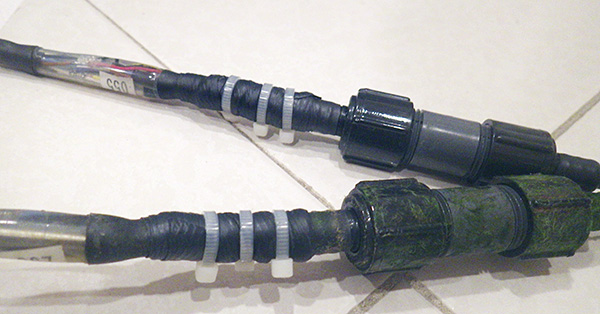
For existing builds, I reenforced the weak points with mastic tape

For the units in the field, I’ve re-enforced the weak points with mastic tape & cable ties to limit bending.

This is good news for me because physical problems are generally the easiest ones to fix…

Up to this point I’ve been using soft silicone jacket cable which is lovely to work with, but I will have to build the next set from sterner stuff.

Of course that means we might have to develop a new set of deployment procedures,  because handling 24m of stiff cable could be a challenge.  These deployments have already been some of the toughest dives on the project, especially when you get into the low-visibility hydrogen sulfide soup that Trish is so fond of…


The second generation builds also used less power than the first:

Much better power performance on the second generation of temp strings.

The battery curve is still a bit crunchy, but it looks like it might settle to about 100 mV drop per month at a 15 minute interval on 2x3AA’s.  That’s nearly the same as the first two loggers which had twice as many cells.  One of the things you notice about cheap DS18b20’s from ebay, is that they can draw dramatically different sleep currents.  This may be compounded by the fairly aggressive 2k2 pullup I use on the bus.


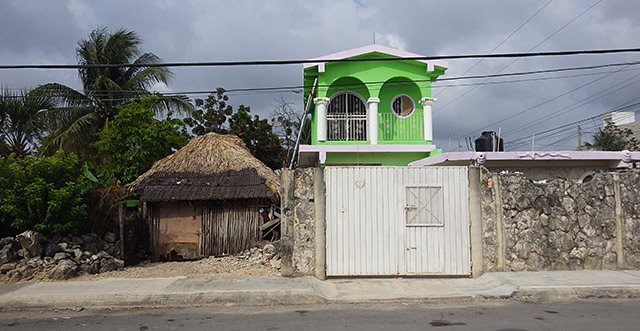
Spotted in Tulum:

Neighbours

Just finding a problem doesn’t always tell you how to fix it…