Category Archives: Developing a FLOW ≋ sensor

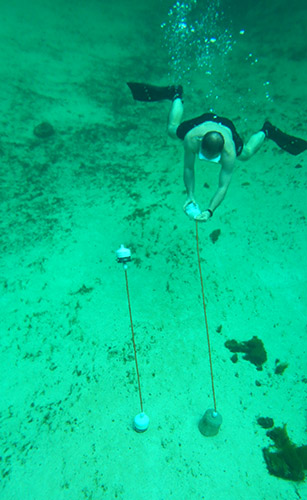
A hydrometric pendulum using drag-induced tilt angles to infer water flow velocity.

For a case study showing the kind of data we collect from these sensors, see:
A Flexible Arduino-Based Logging Platform
at: http://www.mdpi.com/1424-8220/18/2/530

Field Report 2014-03-19: The Cave Pearls have landed!

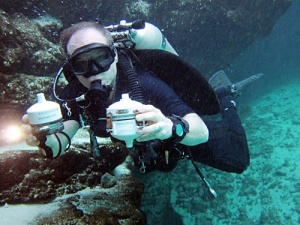
About to surface with the beta loggers.

About to surface with the beta loggers.

All the usual grumbles of getting our kit out of storage and ready to roll delayed the Beta unit retrieval till late afternoon, and I was really chomping on the bit by that point. It was a good haul against the current out to the deployment site, but once there I was very happy to see our little loggers swaying gracefully. After a good visual inspection, to examine the anchors and brush away the sizable clumps of rusty brown goo that had grown on the exposed metal, we popped them into a mesh bag and headed back to the surface.  With my ears above water, I dared a few little shakes to check…had they leaked….?
Breaking the seal.

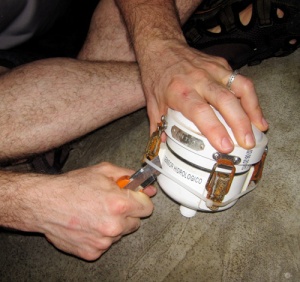
Breaking the seal.

We cradled the loggers all the way back to Tulum while we waited for them to dry out.  After a quick rinse, we stowed the dive gear and then set to work on the pearls. Both of them opened with a satisfying “ssshhhick” indicating that the seals were indeed good. (they were compressed a bit at depth) I have to admit I have been working on the new builds so intensively, I laughed to see the tape that was holding these guys together, and the leggo I had solvent welded into the battery compartments. I checked the hour: it was 7:45pm…perfect time to cut the power, as the units had been left on a 1/2 hour sampling schedule. Once the power was disconnected, I could breathe a sigh of relief, as we  were then safe from any further calamities that might hurt the precious SD cards. But we did not have a reader with us, and as usual, Trish had filled the evenings schedule with meetings with some of the other researchers in town. In the end it was 11:00 pm before we could look at the SD cards and know if our little experiment was truly a success….

And it was! In fact both units were collecting readings right up to the point where I disconnected the battery. Woot! Trish went to work, and I just sat back, impressed by the super sonic “squiggle wrangling”.

“Temps…no trending..but nothing useful there… offsets…”, she was talking to the screen more than to me. No surprise on the temperature data as the readings were from the RTC, completely trapped inside thermal mass of the housing.

“Can you bring up the two voltage curves?” I asked, “I want to know how we did on power consumption.”

“Right.”…clickety, clickety, click… “How’s this?”
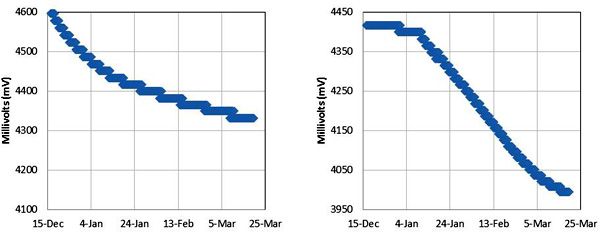
Left: Unit 1    Right: Unit 2 (rubber bottom)

Left: Unit 1 Right: Unit 2 (w rubber bottom)

Quite a difference, but both units had run in the > 4 volt range for three months.  So we had been far too conservative with the 30 minute sampling routine, although I had no way to know that when they went in last year. Pretty much identical components in the build, so for now I am attributing the different power curves to the mix of batteries that were used.

“Z offsets….X and Y as well….” clickity, click… “…easy to fix… and we can do a quick running average for that noise…”

“No, don’t fix it!” I injected, “I want to see the raw data,  side by side.”

Trish’s hands paused, and she dropped out of the excel trance long enough to give me a puzzled look: “Why would you want that?”

I explained that while she was rapidly turning the numbers into something relevant to the actual water flow, I (as the builder) wanted to know how the two units compared to each other, as basic machines…

“Hmmm, Ok”….

Left: Unit1  Right:Unit2  Raw z Axis, sub-sample

Left: Unit1 Right:Unit2 Raw z Axis, sub-sample

The different amplitudes were not a surprise, as our buoyancy control was just best guess approximation. But in theory, the accelerometers were identical, so the offsets were kind of interesting.  Ah well, it will be a while yet before I am at the point of calibrating these things…
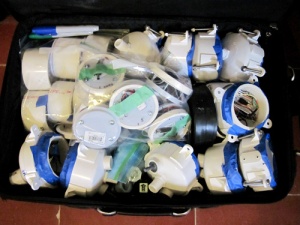
I am still amazed that all this makes it through the airport scanners...

I am amazed that we don’t get more grief from airport security when we travel with this kit.

Trish was still talking to the screen  “mmmm…some finer structures here…”, and clicking away, but it was nearing 1:30 am at this point, and I was starting to fade. I uploaded all the data to a Google doc, and suggested that we call it a day.
I knew what I still had ahead of me ->

I hope that Turtle Bay Cafe doesn’t mind if I take up residency for a few days, while I work on the next generation:

“Mass caffecito porfa…”

<—Click here to continue reading—>

Field Report 2013-12-16: The first long term deployment begins

Dec16_longDeploymentMascot

We discovered a stowaway in the car on our way out to the dive site. Everyone took that to be a good omen.

This was our last day in Mexico, so the flow meters were going in for their first long term installation today.  The over night run trials went smoothly so the last minute rebuild of logger 2 fixed the excessive power drain issue. (whew!)
But all the testing I had done over the last few days (with the units sampling and recording at a furious pace) meant that I had to scavenge the remaining good batteries out of our dive lights for the deployment.  I loaded the loggers with a sketch set to take readings every 30 minutes, and sealed the housings.

Then we loaded up our dive gear and drove to Playa de Carmen, to meet a reporter who had been interviewing Trish over the last few days. She was going to dive with us today to get video of us, and also of the little data loggers, for a documentary she was making about the growing water quality issues in the region.  Unfortunately she was was not a cave diver, so we did a “pretend” deployment on a large mangrove root out in the open water. Once she had captured the footage she needed, Trish and I continued on into the cave.

Because we were uncertain about the weight of the new batteries, we decided to install both units as pendulums for this deployment. The current at this location was pretty strong, so it was a bit challenging to stay in place, while affixing the “ceiling anchors” to the roof of the cave.

After securing the sensors, we did a final swim round to inspect the installation:

Fare well little sensor pods! We will come back in a few months to get you…we promise!

<—Click here to continue reading—>


Field Report 2013-12-06: The moment of truth…

A couple of days into the UNAM research, there was break in the schedule, so we had the opportunity to go back and retrieve the units. When we arrived at the installation site, everything looked exactly as we had left it, with no apparent leaks or other damage to the housings.  But on closer inspection, we did observe that the two units were not exactly behaving the same way:

After catching a little more video, we spent a few minutes collecting the sensors. A short while later we finished the dive, and soon I was carefully cradling the loggers on my lap as we drove back to the CEA dorms. Once there I made sure that the units were absolutely dry before I opened them up to retrieve the SD cards.  I could see from the size of the files that both units ran smoothly, and had logged data. But what had they recorded?

Once the files were on the laptop, my wife, an Excel virtuoso, took over.  Within moments we were starting to see bumpy graphs displaying the three axes of the accelerometer.
A little more adjusting, a few labels, and we were looking at this:

3 days of raw data from the very first deployment.

Raw data from the first deployment: x,y&z axes, but with different orientations relative to flow direction.

“Is that good?” I asked. I could barely contain my excitement.

“Yes,” she replied with a big smile, ” for uncalibrated, first run data, this is pretty good.”

“Why two peaks per day?” I thought there might be a problem with the sensors.

“Actually.” she added, “That’s normal.  This area has semi-diurnal tides, and the velocity curves are often asymmetrical like that.”

“Yaayyyy!” I whooped, “We did it!” And I think I even started dancing.  Months of noodling around in the basement, and combing through forums, had just been transformed from “another one of Ed’s crazy projects…” into two real working prototypes!

It was well into the evening by this point, so we headed out for a late dinner, and a couple of celebratory ‘cervezas’.  We discussed where we might put them next, so that we could learn more about the quality of the data they were generating. I wondered about how we might calibrate them against some commercial units, and Trish said that even without ‘absolute’ velocity numbers, the information would still be useful to her research. But for me,  the real bottom line was the moment when she asked:

“How soon can you make me some more of these things?”

<—Click here to continue reading—>

Field Report 2013-12-03: The Full Monty

Trish ties off Unit 1

Trish ties unit one to the ceiling of the cave.

Although our field tests so far had uncovered buoyancy issues, both designs had remained water tight. So I was feeling brave enough to think about putting the electronics into the housings. And the UNAM crew was arriving in Tulum today, so I was about to loose my dive buddy to “real” research. We decided to go for it and install the little loggers, in a cave system, and leave them there for a few days taking readings every five minutes.

For this first deployment we chose a system that Trish had already calibrated for discharge many times over the years, allowing her to review any data that my little DIY units might produce within that context.  But given the buoyancy issues we had seen over the last few days, we decided to test everything in open water at the entrance.  And it’s a good thing we did as, once again, the o-ring design sank*… as you might imagine, I spent the next few minutes making some rather large bubbles.

…Once I regained my composure, we decided to make lemonade. If that unit was not going to float, then we would simply install it upside down, as a pendulum. The magnitude of the displacement would be almost the same, and all I had to do was change the sign on a few of the readings.  So we grabbed one of the anchors, and a bit braided line from the dive kit, and made our way into the cave.  I carried the anchor and poles, while Trish ran the dive reel leading us into the dark of the cave.  I have to admit I winced a few times as the mesh bag carrying her unit occasionally bashed into the nearby rocks, while her attention was focused on the line. I had visions of those Tinyduino stack connectors coming apart, “But hey” I told myself, “that’s what a this is all about.”  They would either survive the real world, or I would have to go looking for a different electronics platform.

We made our way to a location where we had installed one of the old RCM Aanderaa sensors, many years before. And while I found a place where the anchor didn’t sink elbow deep into the piles of organic mung, Trish tied off the pendulum unit. We did a few laps round the installation with the waterproof camera, to capture a little video, and then made our way back to the entrance. Our loggers were now out in the wild, collecting real flow data! The schedule was pretty busy for the next little while, so it was going to be a few days before we would be able to retrieve our units, to see if they worked. It will be interesting to see how the readings compare to each other.

I have my fingers crossed!

<—Click here to continue reading—>

*Some time later, we found that AA batteries vary considerably in their mass, and I had switched brands just before this deployment, throwing our buoyancy off again.

Field Report 2013-11-30: The first “real world” housing test

I had some serious concerns about the wobble behavior observed during the early housing tests, and that vortex shedding might still kill the whole idea of measuring tilt as a proxy for water velocity. But without some real world observation there was no way to know if this was a lethal design flaw, or just an artifact of plain old surface turbulence. The support poles I had given the student to try out earlier were only 50cm long…

IMGP0171

The new housings get their first real world test.

So, even though we started our trip with a lovely bit of dry caving, I was very keen to get the new housings in the water before Trish started diving with her grad student and the diverse group of UNAM & Texas A&M researchers that would be arriving soon.

We piled all the bits into the rental car, and headed out to a local coastal outflow that was easy to access from the surface. I reasoned that if the units didn’t respond in the high flows at that site, there was no point in trying them out in the slower cave systems.  And, as this was to be the first test in anything deeper than a laundry tub, I decided it was safer to leave the electronics behind, and test them with simple calibration weights inside. We passed the usual gaggle of snorkelers on the way in, who stared curiously at all the plumbing we were carrying. A few continued to circle around above us as I set to work getting the anchors in place,  threading the poles, and attaching the housings.  At least I had proved that the thread plugs were easy to attach under water!

Right from the start the units appeared to be working: they were leaning in the direction of flow, and by 45 degrees (or more). I knew that the 2 G rating on our accelerometer meant we were using less than half the sensors range, but there wasn’t going to be any problem reading a signal that strong. And although we could see some of the wobble that the student had mentioned in the support poles, it was fairly mild except in the fastest flow areas. So the dreaded vortex shedding problem turned out to be far less serious than I had feared. I was happy!

IMGP0172Trish and I spent the next little while swimming around the units, trying to see them from all angles, while the curious onlookers tried to figure out what the heck we were doing. But as we continued discussing the floats, working on where to move them next, a problem was slowly developing. Over the next 15-20 minutes, the o-ring housing, slowly, inexorably, sank to the bottom. The only logical conclusion I could think of was that the seals had failed, and that the Mark II, which I had so carefully assembled, was a failure.

Later, after we had retrieved the units and dried them out at the surface, I cracked open our sinker, preparing myself for….Nothing! It was bone dry inside! How does something sink “slowly” without leaking? I put the cap back on and marched back over to the water, to dunk it in. And it floated, just as it had before, with just a small bump of pvc cresting the water. Hmmmm.

Then I grabbed the hollow support poles, tossed them in, and they floated too.  What was going on?  I moved the tubes around a bit, and spied a few small bubbles leaking out one end…Aaaha! They were not as buoyant as I thought they were. A bit more shaking to fill their internal volume with water, and I managed to get the poles to sink, very, very, slowly.

Then I jumped in, and pushed the housing down to the bottom; to observe it at depth. On the surface, it floated happily, but down around 15 feet, it rose much more slowly.  It dawned on me that I had been compressing the new o-rings for the first time! So the bubbles in the support poles were draining out, and, the internal volume of the housing was also changing with oring compression!

So today was not a failure at all!  I had simply shaved the buoyancy budget too close in my quest for more response to water flow. I could fix this…

<—Click here to continue reading—>